


Hip Arthroplasty Recovery for an Active Return

The first walk after a hip replacement can feel surprisingly big. Your new joint may be structurally ready for movement, but your muscles, balance, confidence, and daily routines need time to catch up. Hip arthroplasty recovery is not about waiting for pain to disappear before you move. It is a progressive process of protecting the surgical site while rebuilding the strength and control that make walking, working, training, and living independently feel natural again.
For active adults, the goal is rarely just getting around the house without discomfort. It is returning to the gym, taking the dog for a longer walk, playing with grandchildren, traveling comfortably, or getting back to the sport that keeps you feeling like yourself. A personalized rehabilitation plan helps bridge the gap between surgery and that return.
What Hip Arthroplasty Recovery Usually Looks Like
Hip arthroplasty is another term for hip replacement surgery. The procedure replaces damaged portions of the hip joint with artificial components to reduce pain and improve function. While the surgery addresses the joint itself, recovery requires your entire movement system to adapt.
Your surgeon's specific instructions always lead the process. Recovery timelines differ based on the surgical approach, whether the procedure was a total or partial hip replacement, your prior activity level, other health conditions, and how well your muscles were functioning before surgery. Some people leave the hospital the same day, while others need a short inpatient stay. Some are using a cane within weeks; others need more time.
In the earliest phase, the focus is straightforward: manage swelling and pain, protect the incision, walk safely with the appropriate assistive device, and begin gentle movement. This is not the time to test your limits. It is the time to establish consistent, quality movement habits.
Many patients progress from a walker to a cane and eventually to independent walking as gait quality, strength, and stability improve. The goal is not simply to stop using the device as quickly as possible. It is to stop using it when you can walk without significant limping, loss of balance, or compensation.
The Real Work Begins After the First Few Weeks
Pain relief is often one of the most noticeable benefits of hip replacement. But reduced joint pain does not automatically mean your hip is ready for every activity. After surgery, it is common to have weakness in the glutes, quadriceps, hip flexors, and trunk muscles. Your body may also retain movement patterns developed before surgery, such as limping, shifting away from the painful side, or relying too heavily on the low back.
This is why rehabilitation should look beyond a checklist of basic exercises. The root cause of poor movement after surgery is not always the hip joint alone. It may involve reduced hip extension, limited pelvic control, poor single-leg balance, stiffness in the surrounding tissues, or strength differences between sides.
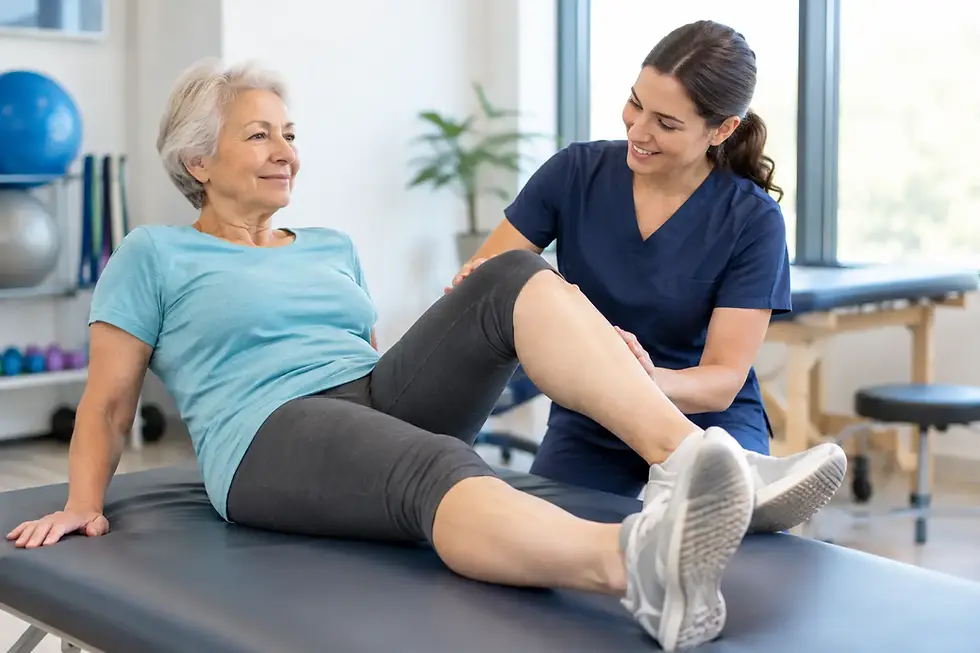
A physical therapist can assess how you walk, sit, stand, climb stairs, and move through the activities that matter to you. From there, your plan should progress from foundational mobility to strength, balance, endurance, and task-specific training.
Mobility without forcing the issue
Early movement supports circulation, helps reduce stiffness, and keeps the surrounding muscles engaged. Depending on your surgical precautions, this may include gentle range-of-motion work, heel slides, supported hip motion, and short walks throughout the day.
More motion is not always better. Pushing aggressively into painful ranges or disregarding surgical precautions can irritate tissues and create setbacks. Your care team should help you distinguish normal post-exercise soreness from pain that signals you need to scale back.
Strength that carries over to real life
Hip strength is essential for more than exercise. Your gluteal muscles help control the pelvis every time you take a step, get out of a chair, climb stairs, or stand on one leg to put on pants. Early strengthening may start with simple muscle activation and controlled bodyweight exercises. Over time, the program should build toward functional loading such as step-ups, squats, carries, and other movements matched to your goals.
The right progression depends on movement quality. Adding resistance before you can control the movement can reinforce compensation. On the other hand, staying with only light exercises for too long can leave you underprepared for the demands of normal life. A good plan advances at the pace your body demonstrates it can handle.
Balance and gait training are not optional extras
A limp can persist after surgery even when pain has improved. Sometimes this is a temporary habit. Other times it reflects weakness, limited motion, fear of loading the new hip, or poor balance. Targeted gait training addresses the pattern rather than hoping it goes away on its own.
Balance work becomes increasingly valuable as you return to uneven ground, curbs, crowded spaces, stairs, and recreational activity. Exercises may begin with supported weight shifts and progress to controlled single-leg work. The objective is confidence built on capability, not confidence based on guesswork.
Milestones Matter More Than a Calendar
Patients often ask when they can drive, return to work, resume the gym, or play a sport. The honest answer is that it depends. A desk job may be possible sooner than a physically demanding job. Returning to a stationary bike is different from returning to pickleball, golf, tennis, running, or heavy lifting.
Time since surgery is one piece of the decision, but it should not be the only one. Before progressing activity, consider whether you can walk without a significant limp, manage stairs with control, tolerate daily activity without a major pain or swelling flare, and demonstrate adequate strength and balance for the task.
For example, an active adult returning to golf needs more than comfortable walking. They need rotational control, hip mobility within safe limits, balance through the swing, and the endurance to handle the course. A runner needs impact tolerance, single-leg strength, and a gradual return-to-run progression. Skipping those steps can turn an exciting return into an avoidable setback.
Common Recovery Mistakes That Slow Progress
The most common issue is doing too much on a good day, then needing several days to recover. A better approach is to increase one variable at a time: walking distance, exercise resistance, time on your feet, or activity complexity. This gives your body a clear opportunity to adapt.
Another mistake is focusing only on the surgical hip while ignoring the rest of the body. The low back, opposite hip, knee, ankle, and core all influence how you move. If one area is working overtime, addressing that compensation can improve comfort and help restore a more efficient gait.
Finally, do not let fear dictate every movement. Caution is appropriate, especially early on, but avoiding all challenge can contribute to persistent weakness and stiffness. Evidence-based rehabilitation provides a safe middle ground: enough protection to respect healing, enough progressive loading to restore function.
When to Contact Your Surgical Team
Some discomfort, fatigue, stiffness, and mild swelling are expected during hip arthroplasty recovery. However, call your surgeon promptly for increasing redness, drainage, fever, chills, calf pain or significant swelling, new shortness of breath, chest pain, a sudden loss of function, or pain that becomes sharply worse rather than gradually improving. These symptoms need medical evaluation, not a tougher exercise session.
Build a Return Plan Around Your Life
Post-surgical rehabilitation should not end at “you can walk.” It should prepare you for the life you want to return to. At Elevation Spine & Sports Medicine, this means individualized, one-on-one care that considers your surgical guidance, your current movement capacity, and the activities that matter most to you.
The best recovery plan is not the fastest-looking one on paper. It is the one that steadily restores mobility, strength, and confidence without sacrificing the progress you have already made. Keep showing up for the small sessions, the controlled reps, and the short walks. Those repeatable wins are what carry you back to the activities you love.


Comments